




Update Location
Enter a ZIP code to get product recommendations and information tailored to your area.

A spreader is how you get granular fertilizer, grass seed, and weed control onto your lawn evenly, and the right one depends less on brand loyalty and more on two things: your lawn’s size and shape. Bonus: the same spreader also handles ice melt on your driveway and walkways come winter, so it's a tool that earns its keep year-round.Here’s how to pick the model that fits your yard, and how to use it once it’s in your hands.
Broadcast Spreaders
A broadcast spreader flings product outward from a spinning disc in a broad, overlapping pattern, so you cover a lot of ground fast. It’s the right call for medium to large lawns without a lot of tight turns or obstacles.

Drop Spreaders
A drop spreader releases product straight down in a narrow band beneath the hopper, giving you much more precise control over exactly where product lands. That precision makes it the better choice for lawns with lots of landscaping, planting beds, narrow strips, or tight turns.

Hand-Held Spreaders
Powered by a battery or a hand crank, a hand-held spreader dispenses product in front of you as you walk. They’re a good fit for small lawns (1,500 sq. ft. or less) or tight spaces a bigger spreader can’t maneuver.

| Lawn Size | Best Spreader | Why |
|---|---|---|
|
1,500 sq. ft. or less |
Scotts Wizz Spreader (battery) or Scotts Whirl Hand-Powered Spreader (crank) |
Compact, lightweight, easy to maneuver in small spaces (see note below) |
|
Up to 5,000 sq. ft. |
Scotts Turf Builder EdgeGuard Mini Broadcast Spreader |
Precision rate settings and EdgeGuard Technology in a manageable size |
|
Up to 15,000 sq. ft. |
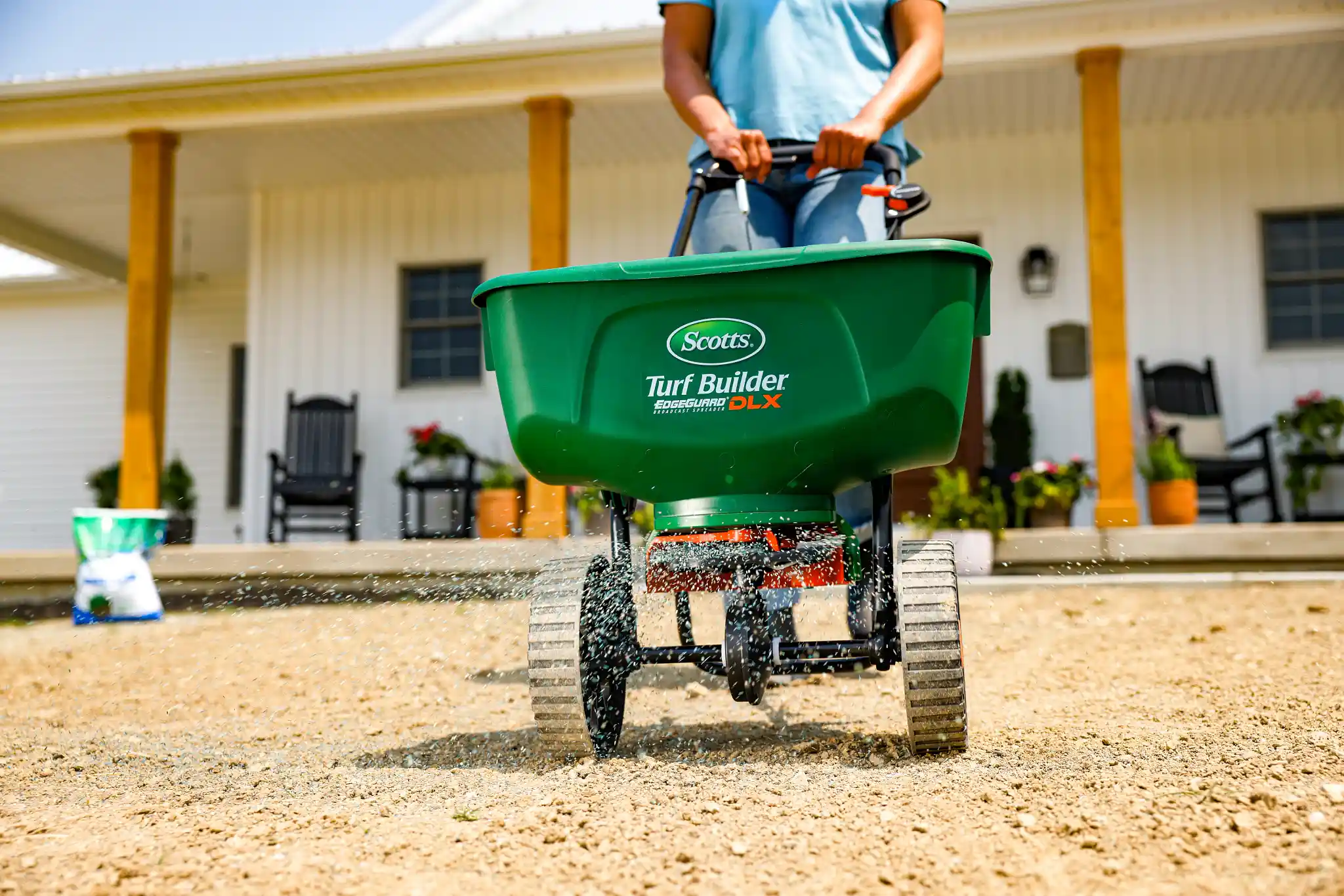
Scotts Turf Builder EdgeGuard DLX Broadcast Spreader |
Larger hopper capacity for fewer refills on bigger lawns |
|
Up to 20,000 sq. ft. |
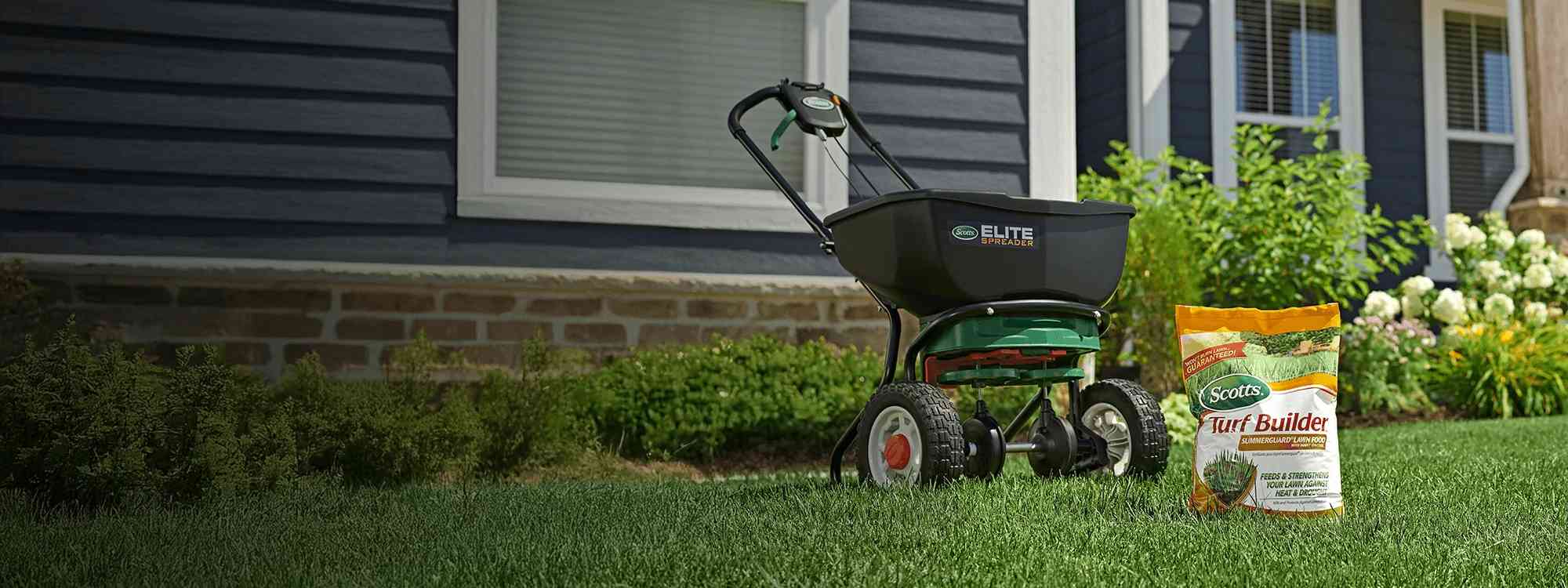
Scotts Elite Spreader |
6-foot spread pattern covers extra-large lawns in fewer passes |
Note: The Wizz spreader has 23 built-in settings and a 1-touch on-off control; the Whirl spreader trades the battery for a hand crank. Both can be used to apply lawn fertilizer and grass seed, but check the product label before loading a weed, insect, or disease control product into the Whirl. Hand-cranking doesn't deliver the same consistent, accurate application as a battery-powered, broadcast, or drop spreader, so most control products aren't labeled for use with hand-powered spreaders.
This is where a drop spreader earns its keep. Instead of flinging product outward like a broadcast spreader, a drop spreader releases it straight down in a precise band directly beneath the hopper—no overspray onto flower beds, garden edges, or narrow strips a broadcast spreader would overshoot. If most of your lawn is open and a broadcast spreader would work fine except for a few tricky spots, some homeowners keep both on hand: a broadcast spreader for the open lawn, a drop spreader for the edges.
Once you’ve got the right spreader, using it well comes down to five steps.
Step 1: Check the Label and Set the Dial
Every Scotts product label lists the correct dial setting for your specific Scotts spreader. Set it before you load the hopper—not after. If you don’t have the bag on hand, the Spreader Settings Lookup Tool will give you the right dial number.
Step 2: Fill the Hopper and Apply the Perimeter Pass
Fill your spreader over a driveway or hard surface, not on the lawn, and sweep up any spills. Then walk the outside edge of your lawn first. Engage the EdgeGuard deflector for this pass if your spreader has it, so product doesn’t land on driveways, sidewalks, or landscaping.
Step 3: Fill In with Parallel Interior Passes
Turn the EdgeGuard off, and walk back and forth in parallel passes along the longest stretch of your lawn.
Step 4: Overlap Each Pass for Even Coverage
Overlap each pass by about 50%, which is roughly wheel-track to wheel-track, and hold a steady, brisk pace—target a 3 mph pace, or about 4 feet per second. Start walking before you squeeze the trigger, and release it before you stop or turn, so you don’t concentrate product in one spot.
Step 5: Clean Up
Return any unused product to its bag, and sweep stray granules off sidewalks, driveways, and garden beds back onto the lawn.


Want to confirm your spreader is actually putting down what the label says? How to Calibrate a Spreader and Find the Right Settings covers how to check.
Uneven stripes almost always come down to overlap or pace. Use the checkerboard method for the most consistent results: set your spreader to half of the recommended rate; apply half your product north-to-south, then the other half east-to-west. The two-pass, crossing pattern means every part of the lawn gets an even dose even if one pass runs a little light. If you’ve already got stripes and want to rule out a spreader problem rather than an application technique, our Spreader Help page covers the mechanical side—clogging, gate issues, and worn parts.
It depends on square footage: hand-held for 1,500 sq. ft. or less, EdgeGuard Mini up to 5,000 sq. ft., EdgeGuard DLX up to 15,000 sq. ft., and the Elite Spreader for lawns up to 20,000 sq. ft.
Both work well for small lawns with fertilizer or seed. The battery-powered Wizz gives you 23 dial-in settings and one-touch control; the hand-crank Whirl doesn’t need batteries. If you're applying a weed, insect, or disease control product, check the label first; the Whirl's hand-crank action isn't accurate enough for applying control products, which need more consistent application than hand-cranking reliably delivers.
One perimeter pass, then parallel interior passes across the rest of the lawn, overlapping each by about 50%, or wheel-track to wheel-track.
You can, especially with the EdgeGuard deflector engaged near the edge, but a drop spreader gives you more precise control right along beds and borders if they’re a significant part of your yard.
No. The same spreader works for both. You’ll just need a different dial setting, which the grass seed’s product label will specify.